Stationary shear vs mobile shear: reading a scrap yard from overhead
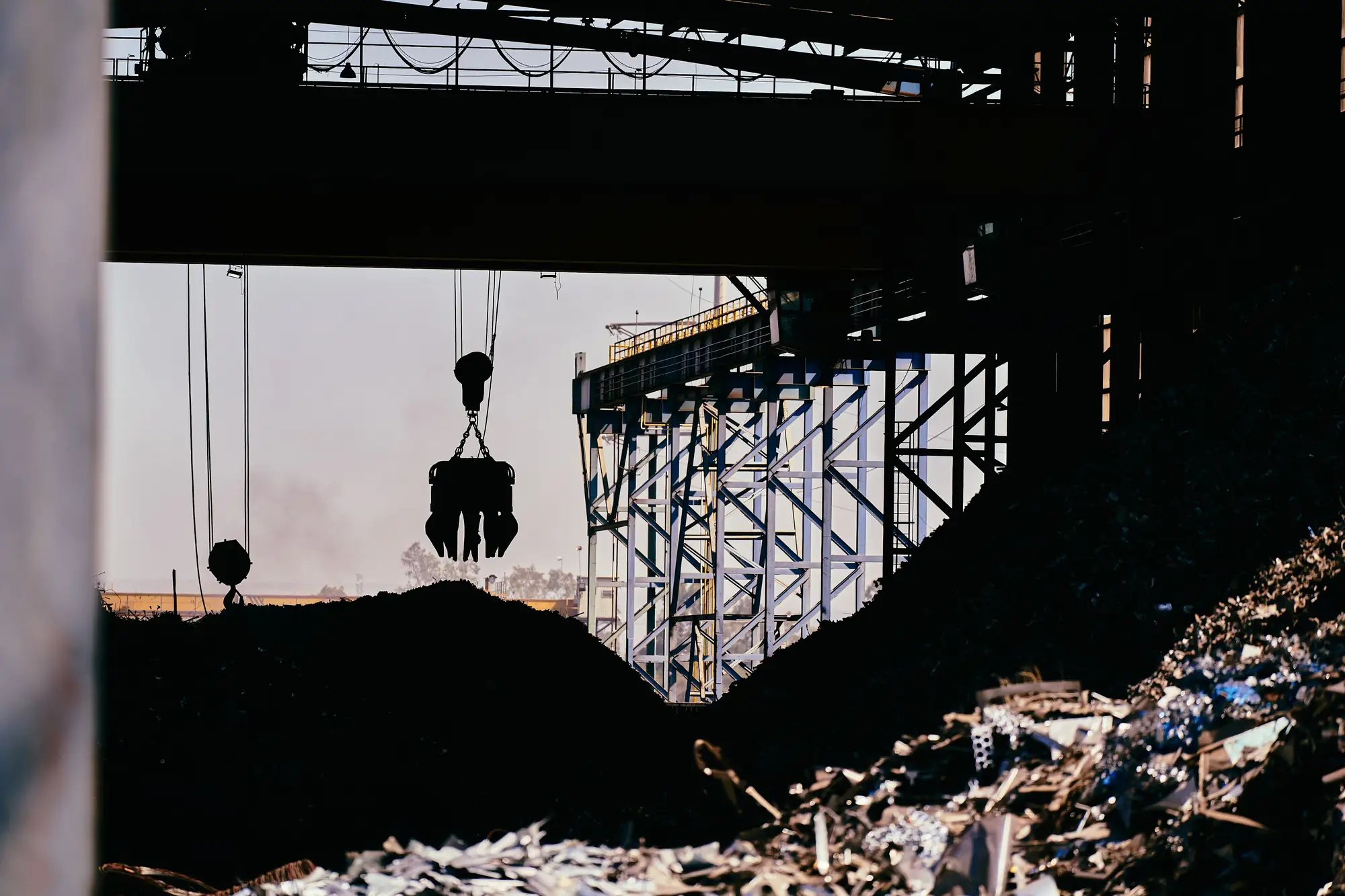
Stare at scrap yard imagery long enough and you'll hit this problem: a shear is a shear, until you need to know if it's bolted to a pad or riding on a carrier. That distinction matters more than it sounds. A stationary shear tells you the yard has committed real capital to a fixed processing line. A mobile shear attachment on an excavator tells you the yard runs flexible, swapping attachments as the work shifts. If you're sizing a market or scouting territory, lumping the two together will give you a fleet count that's technically correct but practically useless.
What you're looking at from directly overhead
At very high resolution (sub-half-meter, the kind of imagery where you can make out individual machine components, not just blobs), the difference comes down to a few things: footprint, position relative to fixed infrastructure, and whether the same unit shows up in the same spot pass after pass.
A stationary shear sits on a concrete pad, usually close to the baler, the shredder infeed, or a loadout area. It has a boxy base unit, often with a feed table or conveyor running into it, and the whole assembly doesn't move. Pull imagery from two different quarters and the shear is in the exact same footprint both times, same orientation. That's your first tell. Fixed equipment doesn't wander.
A mobile shear is an attachment bolted to the end of a material handler's boom, the same chassis that might be running a grapple or a magnet the next week. From overhead you're looking for an undercarriage, either tracked or wheeled, with a boom and a jib extending out to the shear jaw. The machine shows up in different spots on the pad from one pass to the next because it's doing exactly what a mobile unit is supposed to do: feeding piles, sorting, loading trucks, wherever the work is that day.
Shear attachment vs grapple attachment
Once you've sorted stationary from mobile, the next question is what's on the end of that boom. This trips people up because both shears and grapples read as a dark mass at the jib tip at coarse resolution. At finer resolution the shapes diverge. A grapple reads as a rounded, claw-like cluster, roughly symmetrical, because it's built to open and close around an irregular pile.
A shear jaw is more elongated and asymmetric, built to bite through a single beam or a car body rather than scoop a pile. Shadow helps here too: a grapple's shadow tends to be compact and round, while a shear's shadow stretches out along the jaw line.
If you're building a count by machine type across a market, this is the level of detail that actually separates a material handler running a grapple (general handling, loading, sorting) from the same-class machine running a shear (dedicated cutting work). Two visually similar chassis, two very different jobs on the yard.
Why this matters if you're counting fleet across a market
None of this is academic if you're trying to figure out which yards are set up for heavy processing and which are mostly transfer-and-ship operations. A yard with a stationary shear next to a baler and a shredder line is running a different business than a yard with two mobile units working loose piles. For an OEM rep working out where to knock, that distinction changes the pitch entirely, and it isn't something a single static image settles cleanly. It takes a pass that tracks footprint and position over time, which is a big part of what a quarterly per-yard machine count with type breakdown is built to catch.
That's the gap a quarterly per-yard fleet count is built to close for the scrap and recycling segment, and it's worth a look before your next territory push.