What a radial stacker is, and why it runs next to the material handlers
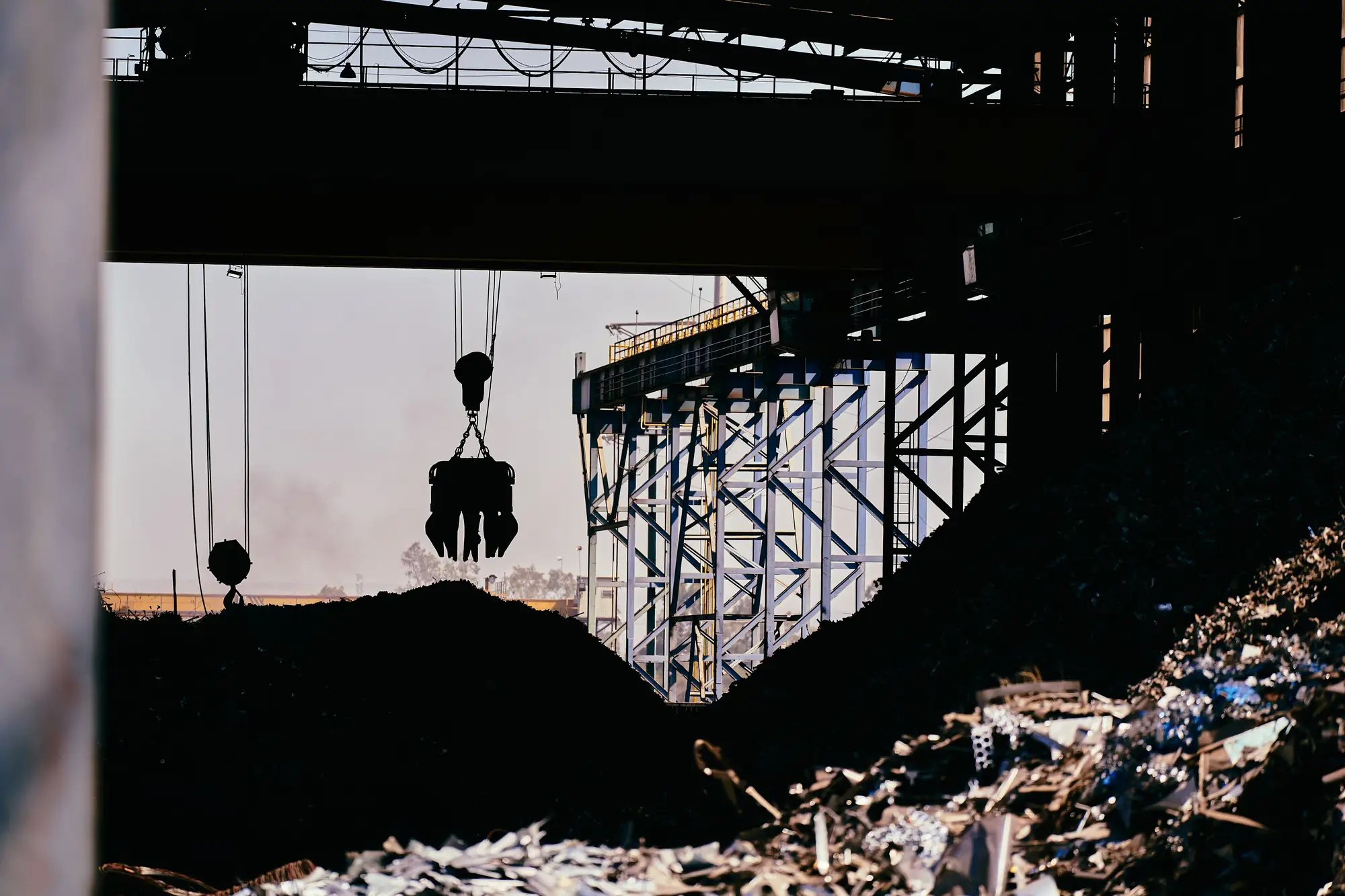
If you've walked a nonferrous yard or a shredder lot, you've seen it: a long conveyor on a pivoting undercarriage, slewing back and forth over a growing cone of material, kicking up a plume of fines in the wind. That's a radial stacker, and it's doing a job none of the material handlers on site are built to do.
What a radial stacker actually does
A radial stacker is a conveyor mounted on wheels or tracks with a radial (pivoting) axis at the feed end. Material comes in at the low end, usually off a shredder discharge, a screen, or a wash plant, and gets carried up the belt to drop at the high end, building a stockpile. Because the whole conveyor can slew left and right on that pivot, and often raise or lower, the operator can lay down a wide fan-shaped pile instead of one tall cone, or walk the discharge point to build a long windrow along a fence line.
The point of the pivot is stockpile volume per square foot of yard. A fixed conveyor builds one cone and stops. A radial stacker spreads the same tonnage over a much larger footprint, which matters when you're working a nonferrous yard where every square foot between the scale and the fence is already spoken for.
Why it runs next to the material handlers, not instead of them
A material handler (a Sennebogen, a Fuchs, a Liebherr-class machine with a grapple or magnet) is a picking and loading tool. It sorts mixed loads, feeds a shredder or shear, loads rail cars and trucks, and moves material short distances with precision. What it's not efficient at is building and maintaining a large stockpile of a single, already-processed material, say, shredded copper wire, shaker-table aluminum, or sized ferrous fines, coming off a continuous process line.
That's the gap the stacker fills. Once material is shredded, screened, or density-separated, it needs somewhere to go, continuously, without a handler operator stopping every few minutes to reposition. The radial stacker takes that discharge stream and parks it in a growing pile while the handlers stay free to do what they're good at: picking loads off the scale, feeding the next batch into the process, and reclaiming from older piles to load outbound trucks and railcars.
Yards that run this combination tend to have a processing line of some kind on site, not just a grapple-and-grab scrap pile. A shredder, a wire chopper, an eddy-current separator, a shaker table. If you see a radial stacker on the satellite view or driving past the fence, it's a reasonable bet the yard is doing more than buying and crushing cars; it's running a nonferrous or sized-ferrous stream through processing and stockpiling the output for sale by grade.
What this tells you before you ever call the yard
For anyone scoping a scrap market, the equipment mix at a yard is a cheap signal of how that yard runs. A lot with three or four material handlers and no stacker is likely buying, sorting, and shipping relatively unprocessed material. A yard with one or two handlers and a radial stacker next to a shredder pad is running its own process line and selling graded output, which usually means a different buyer relationship, different volumes, and a different pitch if you're selling into that yard.
That's the kind of detail that's easy to miss from the road and tedious to collect yard by yard across a whole territory. Scrapyard Fleet Mapping counts the material handlers at every yard in a market on a quarterly pass and breaks them out by type, so you can see which yards are running lean on handlers relative to their size, which is often the tell for a yard built around a processing line rather than a grapple operation.
If you're building a territory list and want the machine mix at every yard before you knock on the first gate, that's what Scrapyard Fleet Mapping is for.